Gender, Men and Masculinities: How the world is shaping the role of men everywhere.
 | So, what is masculinity?According to Raewyn Connell, "masculinities are the patterns of social practice associated with the position of men in any society's set of gender relations." Connell emphasizes that the biology of gender does not determine gender practices. New research have found that there are multiple masculinities, there are hierarchies of masculinities, masculinities are both collective and individual, andthey are constructed in social life. |
To understand masculinity, understanding the gender system, in which masculinities are defined, will give a firm grasp of the word 'masculinity'. The two most popular ways in defining gender are sex roles and sex categories. A less popular definition is gender relation. All three define masculinities differently.
"Role theory" is a theory of society based on the power of custom and social conformity. People learn their roles, in the course of growing up, and then perform them under social pressure. "Sex role" theory explains social patterns by appealing to the social customs that define proper behavior for women and men.
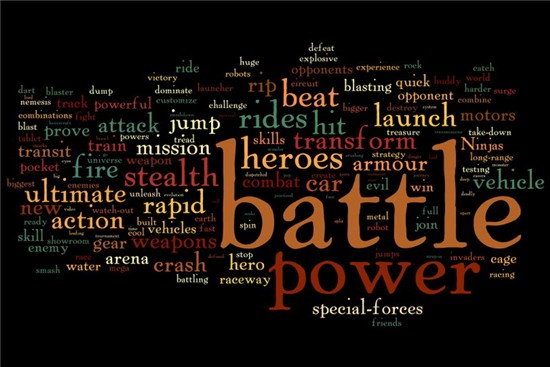
As socially constructed identities, boys and men learn "appropriate" gender roles in accordance to the masculine expectations of their given society. This means that from very early on boys get messages on what it means to be a boy. To illustrate how pervasive the "gendering" process is, we can take a look at how toys are marketed differently for boys and girls. The graphics below are word clouds that display the words used to market toys to girls and boys respectively. The bigger the text, the more frequently it appears in toy marketing material.

Below is a video of how movies teach children manhood. It is an illustration of the "role theory" in gender.
But sex role theory is a weak intellectual argument. It gives no grasp on issues of power, violence, or material inequality. This leads to the second model which is the "categorical" theory. This theory treats men and women as pre-formed categories. Compared with "sex role" theory, this approach more readily addresses issues of power. But categorical theory has difficulty grasping any of the complexities of gender, such as gendered violence within either of the two main categories.
These problems have led a number of theorists towards a third approach, focused on "gender relations." This approach emphasizes that gender issues always concern a structure of social relations.
